 Anir Suren
A few weeks ago Anthropic dropped what a lot of people are calling the most powerful AI model ever put in front of the public. It was called Fable 5. People got a few days with it, went genuinely insane over what it could do, and then it got pulled offline. Now Anthropic just said it's coming back, and the internet is losing it all over again.
Here's the whole story: what Fable 5 actually is, the stuff people were building with it, why it got yanked, and how to make sure you're one of the first people back in when it returns.
Claude Fable 5 and Mythos 5, announced by Anthropic.
What is Fable 5?
Claude normally comes in tiers you already know: Opus is the powerful one, Sonnet is the balanced everyday one, Haiku is the fast cheap one. Fable 5 sits above all of them. Anthropic built one frontier model and shipped it two ways: Fable 5 is the version made safe for the general public, and Mythos 5 is the same model with more of the guardrails removed, handed only to vetted cyber defense and science partners.
In plain English: Fable 5 is the most capable thing they've ever let normal people use, with a few dangerous areas walled off.
The scores, in plain English
Here's the actual comparison Anthropic published. Each row is a different test, higher is better. The highlighted left column is Fable 5 (and its unlocked twin Mythos 5), and the columns to the right are the other big models: Opus 4.8, GPT 5.5, and Gemini 3.1 Pro.
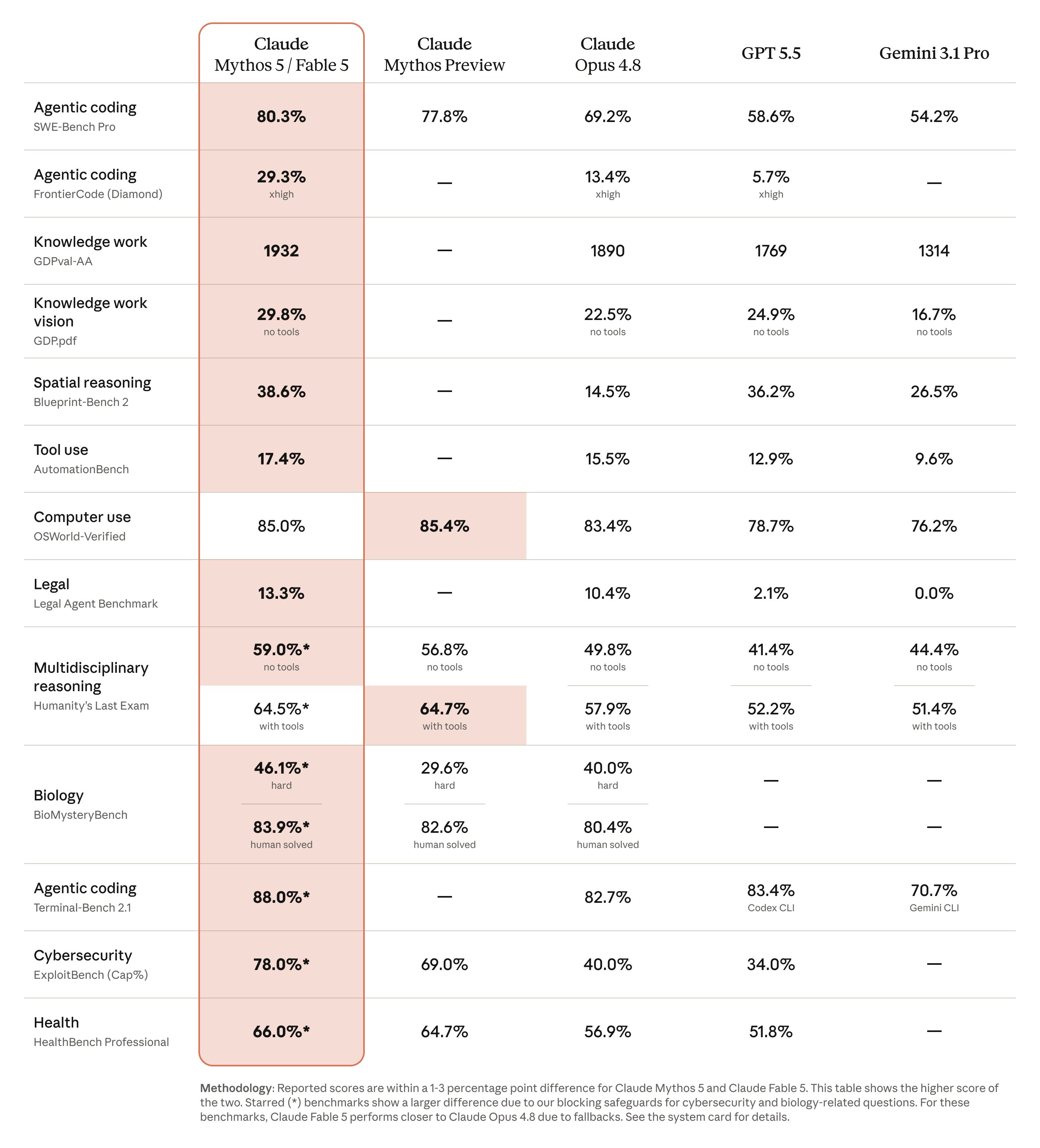
Fable 5 tops almost every row, and it isn't close on the hard ones.
You don't need the test names. The pattern is the whole point: the left column wins nearly every row, and on a few it isn't even close. A few concrete ones:
- Coding: 80.3% on the main agentic coding test, versus 69.2% for Opus 4.8 and 58.6% for GPT 5.5.
- Hard coding: on a brutal one called FrontierCode it hit 29.3%, more than double Opus at 13.4% and roughly five times GPT at 5.7%.
- Real knowledge work: a score of 1932, ahead of every other model on the board.
The stuff people actually built with it
Benchmarks are one thing. What made everyone lose it was the demos. In a few days people used Fable 5 to:
- One-shot working video games and apps from a single prompt, then rebuild an app's code just from a screenshot of it.
- Run entire simulations from scratch, like a physics-accurate solar eclipse, and a fluid simulation synced to a piece of EDM the model composed itself.
- Play games on its own, finishing Pokémon FireRed using vision alone and autonomously strategizing its way through the factory game Factorio.
- Do real engineering work. Anthropic says Stripe used it to run a 50-million-line codebase migration in a single day, work that would take a team about two months by hand.
The headline was never "a new model exists." It's that one model could code, see, reason, and run a computer at a level people hadn't watched an AI hit before.
So why did it get pulled?
Days after launch, on June 12, Anthropic suspended access to both Fable 5 and Mythos 5 over safety and security concerns and said it was working to restore it. That's the "they shut it down" moment everyone was posting about. The model was so capable in sensitive areas like cybersecurity and biology that it got taken offline while the safeguards got sorted out.
There's a clever safety piece worth knowing: on the public Fable 5, when it detects a question heading into dangerous cyber or bio territory, it quietly hands that request off to the older Opus 4.8 instead. Anthropic says that only kicks in on under 5% of sessions, so for normal work you're getting the full model.
How to use it when it's back
This is the easy part. When access returns:
- Open the Claude app or claude.ai, start a new chat, and pick Fable 5 from the model dropdown. At launch it was included on the Pro, Max, Team, and Enterprise plans.
- If you build with the API, the model name is
claude-fable-5. Pricing at launch was $10 per million input tokens and $50 per million output tokens, so it's a premium model, not an everyday cheap one. - Talk to it exactly like you would ChatGPT or any other Claude model. The difference is what it can pull off on the harder stuff.
The exact return date keeps moving, and the last time it came online it did not stay up long. If you want to actually catch it this time, drop your email in the box below. The moment Fable 5 is back for everyone, I'll send you a one-line message so you can go use it before it fills up again.
This was the most fun I've had watching an AI launch in a long time, and it's about to happen again. Get your email in below so you don't miss the window.
– Anir
If you want this kind of AI actually working inside your business, apply to work with me. And to catch every launch like this the second it drops, join the newsletter.