 Anir Suren
Anthropic just dropped a new model and barely anyone is talking about it. It's called Sonnet 5, and it's the upgrade to Sonnet 4.6, the version most people were using until now. The short version: it's a real jump, not a tiny one, it's cheaper than the top Claude model, and right now there's an actual discount on the API for a limited window.

Claude Sonnet 5, announced by Anthropic.
Here's what actually changed, the real test scores in plain English, how to switch it on in about 30 seconds, and the discount you can grab while it lasts.
What is Sonnet 5?
Claude comes in a few tiers. Opus is the heavyweight, Haiku is the fast and cheap one, and Sonnet sits in the middle: smart enough for almost everything, but quicker and cheaper than Opus. Sonnet 5 is the newest version of that middle tier, and Anthropic built it to be the most agent-like Sonnet yet. In plain terms, it closes most of the gap with the expensive top model while staying at the cheaper Sonnet price.
The test scores, explained simply
Here's the actual comparison Anthropic published. Each row is a different test, and higher is better. The left column is the new Sonnet 5, the middle is the old Sonnet 4.6, and the right is Opus 4.8, the pricey top model.
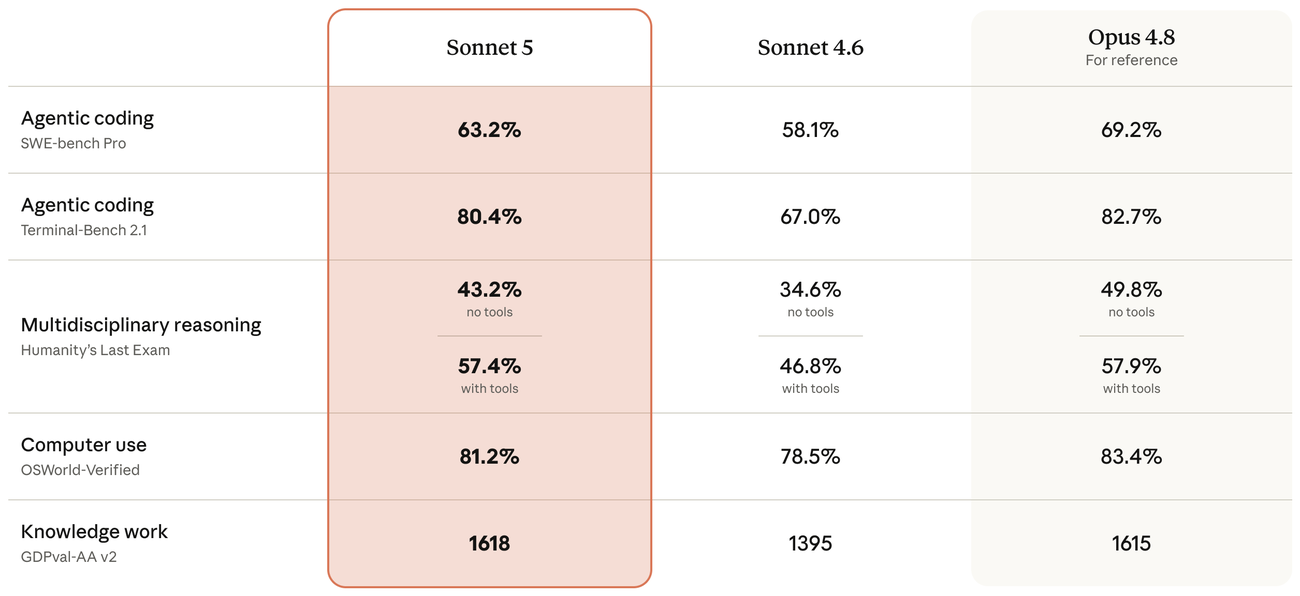
Sonnet 5 beats the old Sonnet 4.6 on every row, and lands close to Opus.
You don't need to know the test names. The pattern is what matters: Sonnet 5 (left) beats the old version (middle) on every single row, and gets close to the expensive model (right). A few concrete ones:
- Coding: on one coding test it went from 67% up to 80%, and on a harder one from 58% to 63%.
- Running a computer: from 78.5% up to 81.2%, basically matching the top model.
- Hard reasoning: from 34.6% up to 43.2% on a brutal "expert exam" style test.
What's actually new
- It's a real AI agent now. The biggest gain is in getting things done on its own: using tools and your computer to finish multi-step tasks instead of just describing them. It also checks its own work more and makes things up less often.
- It actually uses your computer well. The chart below is how well each model operates a computer to complete real tasks. The orange line is Sonnet 5. It sits well above the old version and nearly touches the top model, and it does it for less money per task (that's what the left-to-right axis means).
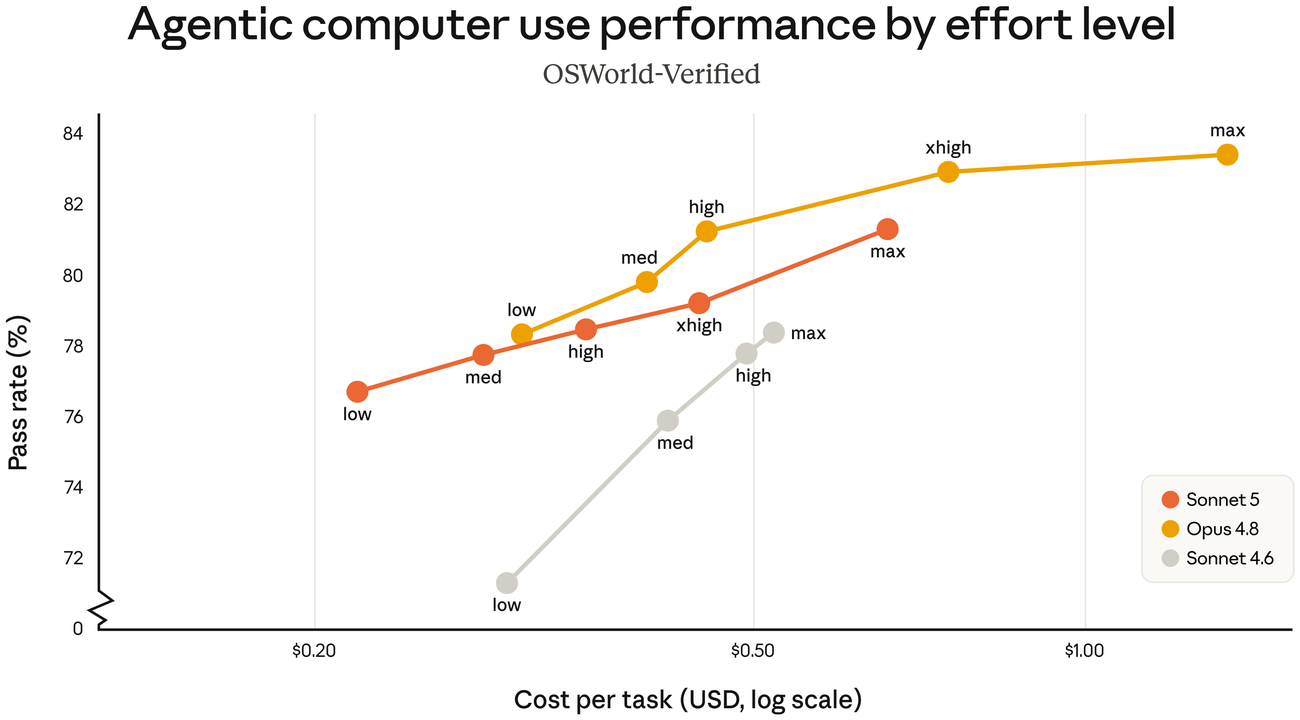
Computer use: Sonnet 5 (orange) sits near the top model for less cost per task.
- Better at research and search. Same story when it goes and digs things up across the web. Sonnet 5 (orange) beats the old version at every setting and again approaches the top model.
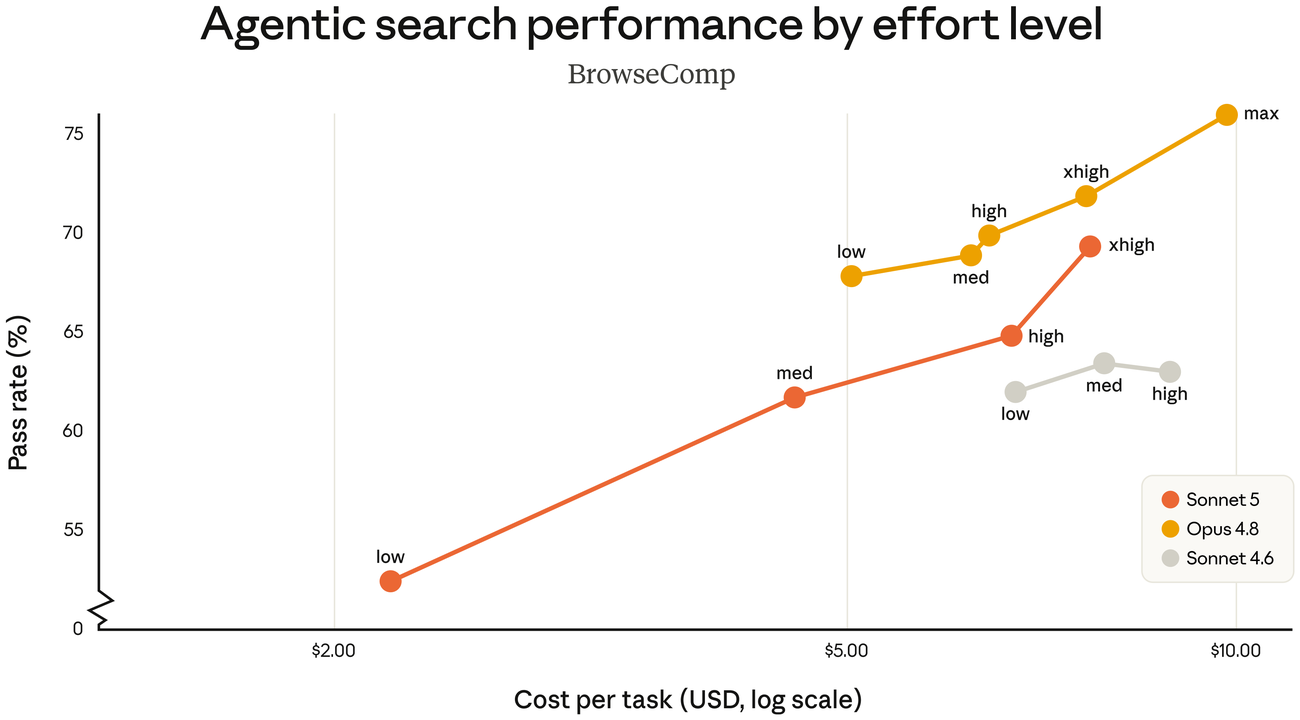
Web research: same pattern, the new model pulls clearly ahead of 4.6.
The headline isn't "a new model exists." It's that the cheaper middle tier now does what the expensive tier did a few months ago.
How to use it (in the app)
This is the easy part. If you have Claude open, you're 30 seconds away:
- Open the Claude app or claude.ai and start a new chat.
- Click the model dropdown at the top of the chat (it shows whichever model you're on now).
- Select Sonnet 5 from the list.
- That's it. Talk to it exactly like you would ChatGPT or any other model. It's already the default on the free and Pro plans, so you may be on it without doing anything.
How to use it (the API, and the discount)
If you build with the API, the model name is claude-sonnet-5. Drop that in wherever you set your model and you're done.
Here's the part worth moving on. Anthropic is running introductory pricing: $2 per million input tokens and $10 per million output, down from the standard $3 and $15. That intro rate runs through August 31, 2026, then it goes back to normal. So the "discount for a couple months" is real, and it's a checkable date, not a vibe. If you're going to run real volume through it, the intro window is simply cheaper. You can confirm the current numbers on Anthropic's announcement.
Should you switch?
For most people, yes, and it costs you nothing to try. If you were on Sonnet 4.6, Sonnet 5 is a straight upgrade at the same price tier. If you were paying for Opus mostly for coding or agent-style tasks, test Sonnet 5 first, because it may do the job for less. The only reason to stay on Opus is the genuinely hardest, longest problems where you want the absolute ceiling. For everyday work, research, writing, and building, Sonnet 5 is the new default.
Go flip the dropdown to Sonnet 5 and run it on whatever you were about to do anyway.
– Anir
If this is the kind of AI thinking you want working on your own business, apply to work with me. And to catch the next breakdown, join the newsletter.